|
|
| Home Group Sites Subject Sites Individual Sites Educational Sites Other | ||
|
Subject Sites Sites for Educators/Students Other
|
Photosynthesis Web Resources
Sites by Subject Broad Overview Sites “The Photosynthetic Process” by John Whitmarsh and Govindjee (http://www.life.illinois.edu/govindjee/paper/gov.html) is a comprehensive chapter that covers photosynthesis history and every facet of photosynthesis research in a relatively detailed manner. J. M Farabee from Estrella Mountain Community College has written a highly recommended online biology course text that includes a detailed section on photosynthesis with emphasis on the physical aspects of the process. He also includes review questions, learning objectives and a nicely done illustrated glossary (http://www.emc.maricopa.edu/faculty/farabee/BIOBK/BioBookPS.html). The Encyclopaedia Britannica article on photosynthesis is available at: http://www.britannica.com/EBchecked/topic/458172/photosynthesis. June B. Steinberg’s site at http://faculty.nl.edu/jste/photosynthesis.htm has easy-to-understand explanations and links to more detailed information. There are many useful animations. Molecular Expressions at Florida State University has a wonderful animated Web page as part of its “Optical Microscopy Primer” (http://micro.magnet.fsu.edu/primer/java/photosynthesis/index.html). There is much here to enjoy and it is fun to roam around through the site. For example, see the section on “Light and Color” (http://micro.magnet.fsu.edu/primer/lightandcolor/index.html) which defines and explains what light is and concepts such as fluorescence, reflection, refraction, human perception of color, lasers, etc. A truly wonderful site! FT Exploring has a wonderful site, “Photosynthesis: How Life Keeps Going...and Going...and Going...,” for students (http://www.ftexploring.com/photosyn/photosynth.html). It covers the details of photosynthesis and how it relates to the rest of life. There is much good information here, as well as good humor and illustrations. (Interestingly, FT stands for “Flying Turtle,” the mascot of this clever Web site.) The American Society of Photobiology has posted “Basic Photosynthesis” by Thomas Brennan: http://www.photobiology.info/Brennan.htm, and “Systems Biology of Photosynthesis” by Xin-Guang Zhu: http://www.photobiology.info/Zhu.html Ted Ed presents an easily-understood animated overview of photosynthesis for younger students at “The simple story of photosynthesis and food – Amanda Ooten” (http://ed.ted.com/lessons/the-simple-but-fascinating-story-of-photosynthesis-and-food-amanda-ooten ). Specific Subject Sites The Joint Center for Artificial Photosynthesis (JCAP) (http://solarfuelshub.org/index.html) is a DOE Energy Innovation Hub studying artificial solar-fuel generation. It is located at the California Institute of Technology and includes researchers from several major universities. The Swedish Consortium for Artificial Photosynthesis (1994–2005) (http://www.fotomol.uu.se/Forskning/Biomimetics/consortium/index.shtm) discusses their research goals of using artificial photosynthesis to produce hydrogen. The Michael Wasielewski group at Northwestern University (http://chemgroups.northwestern.edu/wasielewski/research_apsolarfuels.html) discusses their work designing an artificial reaction center. MIT News presents “Capturing energy form the sun” (http://web.mit.edu/newsoffice/2013/capturing-energy-from-the-sun.html ) an article about the work done there incorporating nanotubes that serves as light-harvesting antenna. “Energy at the Speed of Light” by Andrew Gathman at Penn State University (http://www.rps.psu.edu/0009/energy.html) is a news item worth reading. “Running on sun” (http://www.rsc.org/chemistryworld/2012/09/artificial-photosynthesis-sustainable-energy ) from Chemistry World describes the efforts to create sustainable energy using artificial photosynthesis. “Theory and Modeling of Biological Nanodevices” by Klaus Schulten at the UIUC (http://www.foresight.org/Conferences/MNT8/Abstracts/Schulten/) contains a brief summary of using photosynthesis to develop nanodevices, an area of research that is pushing the envelope of photosynthesis research. “Reinventing the Leaf” by Philip Ball in Nature: Science Update (http://www.nature.com/nsu/991007/991007-3.html): It is a news item worth reading. The Photovoltaic & Optoelectronic Devices group at Universitat Jaume I (UJI), Castellón de la Plana, Spain, is also working on a leaf-like device created using nanotechnology: “Artificial photosynthesis turns water into hydrogen” (http://optics.org/news/3/6/7). “How Artificial Photosynthesis Works” from HowStuffWorks discusses several aspects of artificial photosynthesis in an easy-to-understand manner (http://science.howstuffworks.com/earth/green-technology/energy-production/artificial-photosynthesis.htm). YouTube video “The Artificial Leaf” (http://www.YouTube.com/watch?v=c-s_c6HjDwM) Daniel Nocera discusses the possibilities in this award winning video by Jared P. Scott and Kelly Nyk. (3:46 min.) YouTube video “Nocera Leaf” (http://www.YouTube.com/watch?v=ztdzTyVFtZg) is a clever video with animations that discusses the work of the Nocera lab. Bioenergy / Biofuels / Solar Fuel / Biomass Steve Chu, former Secretary of the US Department of Energy, and the Nobel Prize laureate from Lawrence Berkeley lab, writes about the promise of photosynthesis in “Worldwide Energy Crunch: Power to the people – and how to keep it coming” (http://www.sfgate.com/cgi-bin/article.cgi?f=/c/a/2005/07/17/EDGFVC9JA51.DTL&hw=Steve%2BChu&sn=001&sc=1000). Steve Chu also has a Facebook site for those that are interested, http://www.facebook.com/stevenchu. “Renewable Biological Systems for Alternative Sustainable Energy Production” from the Food and Agriculture Organization of the United Nations (http://www.fao.org/docrep/w7241e/w7241e00.htm): The site provides a great deal of basic information with chapters on biological energy production from photosynthetic organisms. The American Society of Photobiology has posted “Applied Photosynthesis for Biofuels Production” by Michael Seibert: http://www.photobiology.info/Seibert.html The Center for Bioenergy and Photosynthesis at Arizona State University (ASU) contains numerous links to this developing area of research (http://bioenergy.asu.edu). As mentioned above, the center is a large multidisciplinary group and incorporates the former “ASU Center for the Study of Early Events in Photosynthesis.” The ASU Research Magazine has two articles about recent activities. "Catching some rays: Harnessing the power of photosynthesis" (http://researchstories.asu.edu/stories/catching-some-rays-harnessing-power-photosynthesis-945) discusses the history and evolution of photosynthesis and its potential to develop sustainable energy sources. "Bacteria for biofuel" (http://researchstories.asu.edu/stories/bacteria-biofuel-934) discusses current projects to develop biofuels from cyanobacteria. Producing hydrogen from microorganisms is the topic of "Bacteria and sunlight make clean, green hydrogen" (http://researchstories.asu.edu/stories/bacteria-and-sunlight-make-clean-green-hydrogen-844).
Fig. 2: Cover of a brochure describing the work done by the Laboratory for Algae Research and Biotechnology (LARB) at ASU (http://larb.asu.edu/files/biofuel_brochure.pdf). Arizona State University is also the home of the Laboratory for Algae Research and Biotechnology (LARB) (http://larb.asu.edu/) run by Milton Sommerfeld and Qiang Hu. See Fig. 2. Their site contains links to their research, grants and videos. There is also a good PDF file on biofuels (http://larb.asu.edu/files/biofuel_brochure.pdf). The researchers' work was listed as one the best inventions for 2008 in a Time magazine article, (http://www.time.com/time/specials/packages/article/0,28804,1852747_1854195_1854150,00.html). A TED Talk by Jonathan Trent on “Energy from floating algae pods” is available at http://www.ted.com/talks/jonathan_trent_energy_from_floating_algae_pods.html. Another TED Talk by Craig Venter discusses “DNA and the Sea” (http://www.ted.com/talks/craig_venter_on_dna_and_the_sea.html), showing the possibilities of using synthetic biology to engineer organisms in the hopes of creating alternative fuels. Video from UIUC on the tall grass Miscanthus that is a candidate for ethanol production, http://news.illinois.edu/slideshows/Miscanthus_Yield/index.html. Wikipedia has a good entry on “Biohydrogen reactors”: http://en.wikipedia.org/wiki/Biological_hydrogen_production “Biomass” from the Dept. of Energy’s Energy Kids site has a good explanation of biomass for K-12 students (http://www.eia.gov/kids/energy.cfm?page=biomass_home-basics). The US Department of Energy (DoE) has funded a number of Energy Frontier Research Centers (EFRC) (http://science.energy.gov/bes/efrc/) related to photosynthesis and bioenergy. As part of the mandate from the DoE, these sites post progress reports as well as other important information. Arizona State University is home to one of the EFRC centers, the Center for Bio-Inspired Solar Fuel Production (http://solarfuel.clas.asu.edu). The goal is to produce hydrogen or other solar fuels from sunlight utilizing artificial photosynthesis. Washington University, St. Louis: Photosynthetic Antenna Research Center (PARC) http://parc.wustl.edu. They also have a Facebook site: https://www.facebook.com/WUParc?fref=ts. University of Delaware: Center for Catalytic Science & Technology: http://www.che.udel.edu/ccst/ Purdue University: Center for Direct Catalytic Conversion of Biomass to Biofuels (C3Bio): http://www.purdue.edu/discoverypark/c3bio/index.php, plus they have a Twitter site: http://twitter.com/c3bio Donald Danforth Plant Science Center: Center for Advanced Biofuels Systems (CABS): http://www.danforthcenter.org/cabs/ Penn State: Center for Lignocellulose structure and formation: http://www.lignocellulose.org/ The University of North Carolina at Chapel Hill: Solar Fuels & Next Generation Photovoltaics: http://www.efrc.unc.edu/index.html. Artificial Photosynthesis is one of the areas of research for this new center. The Arizona Solar Center (http://www.azsolarcenter.org/) contains a great wealth of information on solar energy activities in Arizona, including information for consumers and the general public. Video: Bruce Bare and Shulin Chen from the University of Washington Denman Forestry Institute present a lecture on “Bioenergy and Biofuels: An Overview of Bioenergy and Biofuels Production.” (http://www.YouTube.com/watch?NR=1&feature=endscreen&v=zm1z9vZ4K0k) (57:41 min.). Video: Daniel Nocera and Angela Belcher discuss “The Role of New Technologies in a Sustainable Energy Economy,” a long lecture (1 hour, 32 min.) presented by MIT (http://video.mit.edu/watch/the-role-of-new-technologies-in-a-sustainable-energy-economy-9193/). In a second lecture in the MIT series, Nocera discusses “Personalized Energy,” in which he discusses his opinions on a “solution to the energy challenge rests in providing the non-legacy (developing) world a carbon-neutral, sustainable energy supply.” (http://video.mit.edu/watch/personalized-energy-9528/) (1 hour, 37 min.) An interesting quote from the MIT Web page (http://web.mit.edu/newsoffice/2009/nocera-video.html) is: Oxygen Evolution /Oxygen-Evolving Complex/Water splitting
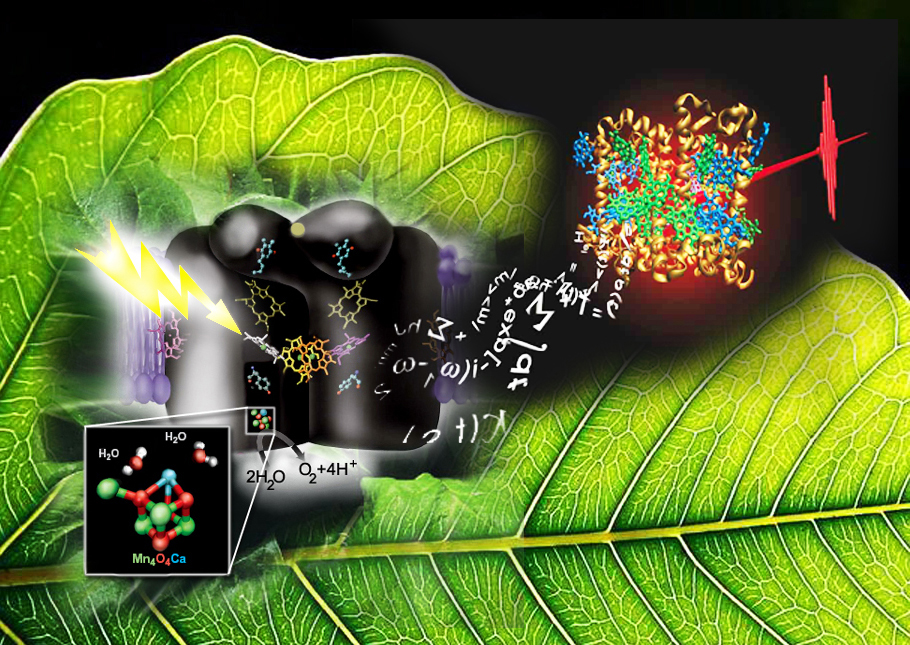
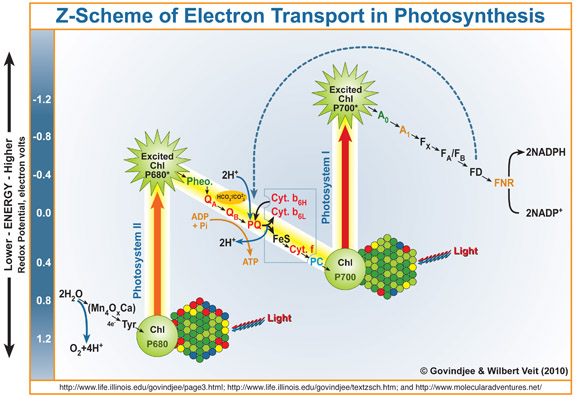
Fig. 3. “An impressionistic look at photosynthesis: at left, the oxygen-evolving complex in Photosystem II (Vittal Yachandra/Junko Yano lab); at right, electronic energy transfer in photosystem II’s light harvesting complex as simulated by supercomputers at NERSC, the National Energy Research Scientific Computing Center (Graham Fleming group).” (http://newscenter.lbl.gov/feature-stories/2012/01/05/atom-specific-chemistry/) The Berkeley Lab at the Lawrence Berkeley National Laboratory has an updated article on “The Next Big Step Toward Atom-Specific Dynamical Chemistry” that discusses the oxygen-evolving complex (http://newscenter.lbl.gov/feature-stories/2012/01/05/atom-specific-chemistry/). See also Fig. 3. Another article, “Spinach, Or The Search For The Secret Of Life As We Know It” (http://www.lbl.gov/Science-Articles/Archive/sb/July-2004/2_spinach.html) appeared in “Science Beat” from the Berkeley Lab and discusses the evolution of the oxygen-evolving complex. The American Society of Photobiology has posted “Oxygen Evolution” by Charles F. Yocum: http://www.photobiology.info/YocumOxy.html “The Manganese-Calcuim Oxide Cluster of Photosystem II and its Assimilation by the Cyanobacteria” by James D. Johnson covers the evolution of the oxygen evolving complex http://www.chm.bris.ac.uk/motm/oec/motm.htm). It is a very detailed article with many illustrations. The National Renewable Energy Laboratory also has a good site on “Hydrogen & Fuel Cells Research” (http://www.nrel.gov/hydrogen/proj_production_delivery.html) that covers many aspects of water splitting, biological and other. A 2012 press release (http://www.teknat.umu.se/english/about-the-faculty/news/newsdetailpage/first-snapshots-of-the-electronic-structure-of-a-manganese-complex-related-to-water-splitting-in-photosynthesis.cid202064) from Umea University describes the use of using an X-ray free-electron laser to study how manganese splits water in photosynthesis. The Light-Dependent Reactions (Light Reactions) From the Botany Online site at the University of Hamburg (http://www.biologie.uni-hamburg.de/b-online/e24/24c.htm), we get a brief history of the elucidation of the dark and light reactions. This is followed by an excellent description of phosphorylation and the two photosystems. The site is profusely illustrated. The Z-Scheme (Fig. 4) is the crux of the light reactions of photosynthesis. A simplified scheme and its description are presented at http://www.life.illinois.edu/govindjee/textzsch.htm. [For the scheme itself, see http://www.life.illinois.edu/govindjee/ZSchemeG.html]
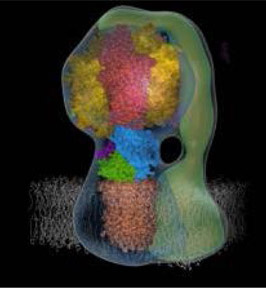
Fig. 4. Z-Scheme of Electron Transport in Photosynthesis. by Govindjee and Wilbert Veit, 2010. Full figure legend is available at http://www.life.illinois.edu/govindjee/Z-Scheme.html. [Science teachers in High Schools and Colleges have the possibility of obtaining a copy of this scheme for their classrooms by writing to Govindjee (gov@illinois.edu)] Wikipedia has a very detailed article covering the “Light-dependent reactions” (http://en.wikipedia.org/wiki/Light-dependent_reactions) with numerous links to related subjects. June Steinberg from National-Louis University has created animations to explain the light reactions using cyclic (http://faculty.nl.edu/jste/photosynthesis.htm) and non-cyclic photophosphorylation (http://faculty.nl.edu/jste/noncyclic_photophosphorylation.htm). The biology department at Smith University has created a very nice animation that shows four stages of the process (http://www.science.smith.edu/departments/Biology/Bio231/ltrxn.html). “Cyclic and Noncyclic Photophosphorylation” is a nice animation from McGraw-Hill (http://highered.mcgraw-hill.com/olc/dl/120072/bio12.swf). The Khan Academy has a couple useful animated class lectures on the light reactions of use to middle- and high school students. The first is “Photosynthesis: Light Reactions 1” (https://www.khanacademy.org/science/biology/photosynthesis/v/photosynthesis--light-reactions-1). The second is “Photosynthesis: Light Reactions and Photophosphorylation” (https://www.khanacademy.org/science/biology/photosynthesis/v/photosynthesis---light-reactions-and-photophosphorylation). Both are well done in the typical Salman Khan manner. YouTube video on “Photosynthesis (Light Reactions)” from North Dakota State University is at : http://www.YouTube.com/watch?v=hj_WKgnL6MI. 5 min. A cute YouTube video featuring a couple well-known babies from television commercials gives an elementary explanation of the “Light and Dark Reactions” (http://www.YouTube.com/watch?v=fVRl4nzMDAU). Light-Independent Reactions (Dark Reactions)/Calvin-Benson Cycle/Carbon Cycle Although the light-independent carbon cycle is often referred to as the Calvin Cycle, it is more accurate to call it the Calvin-Benson Cycle to fully acknowledge the contributions of both Melvin Calvin and Andrew Benson to the research that led to its discovery and description. “The Carbon Cycle” from NASA’s Earth Observatory, http://earthobservatory.nasa.gov/Features/CarbonCycle/printall.php, is very detailed and covers a broad area including differences in the carbon cycle on land and in the oceans, the effect of humans on the cycle, and use of satellites to gather data. Wikipedia has a good article on the Calvin-Benson Cycle (http://en.wikipedia.org/wiki/Calvin_cycle) as well as on the “Light-independent reactions” (http://en.wikipedia.org/wiki/Light-independent_reactions). The Khan Academy video “Photosynthesis: Calvin Cycle” is a good explanation of the Calvin-Benson cycle for advanced middle and high school students (https://www.khanacademy.org/science/biology/photosynthesis/v/photosynthesis---calvin-cycle). The TED Ed site has a good animated lesson on the carbon cycle by Nathaniel Manning (http://ed.ted.com/lessons/the-carbon-cycle-nathaniel-manning). From June B. Steinberg of National-Louis University (http://faculty.nl.edu/jste/calvin_cycle.htm), we have a beautifully done site; the steps are clearly shown. From Smith College, we have interesting animations showing the various steps of the carbon cycle (http://www.science.smith.edu/departments/Biology/Bio231/calvin.html) Joyce J. Diwan at Rensselaer Polytechnic Institute has a site with a very detailed explanation with numerous illustrations and links to PowerPoint presentations and test questions at http://www.rpi.edu/dept/bcbp/molbiochem/MBWeb/mb2/part1/dark.htm. YouTube video, “Carbon Cycle 2.0” (http://www.YouTube.com/watch?v=k0R43K0pKt0) is a I hour video, presented by Paul Alivisatos of the Berkeley Lab on the carbon cycle and how human activity is affecting the planet. A related video discusses “Just Say No to Carbon Emissions” (http://www.YouTube.com/watch?v=jAJRWvkx5n8). The Photosynthetic Unit/Reaction Centers Wikipedia has a good introduction to the “Photosynthetic Reaction Centre” (http://en.wikipedia.org/wiki/Photosynthetic_reaction_centre). “Quantum Biology of the PSU” from the Theoretical and Computational Biophysics Group at UIUC (http://www.ks.uiuc.edu/Research/psu/psu.html): It is a great site showing beautiful structures of antenna of bacterial systems (Fig. 5).
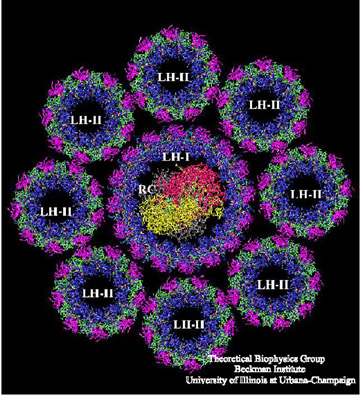
Fig. 5. Structure of the photosynthetic unit from http://www.ks.uiuc.edu/Research/psu/psu.html. “Schematic Diagram of a Photosynthetic Unit Showing Exciton Transfer” is an animated Web page from the University of Hamburg (http://www.biologie.uni-hamburg.de/b-online/library/bio201/psunit.html): It is lovely to watch it. The Roger Hangarter lab at Indiana University (http://www.bio.indiana.edu/~hangarterlab/courses/b373/lecturenotes/photosyn/et.html) contains a brief overview and some details of the PSU. The American Society for Photobiology has posted “Photosynthetic Reaction Centers” by Charles Yocum: http://www.photobiology.info/Yocum-PRC.html
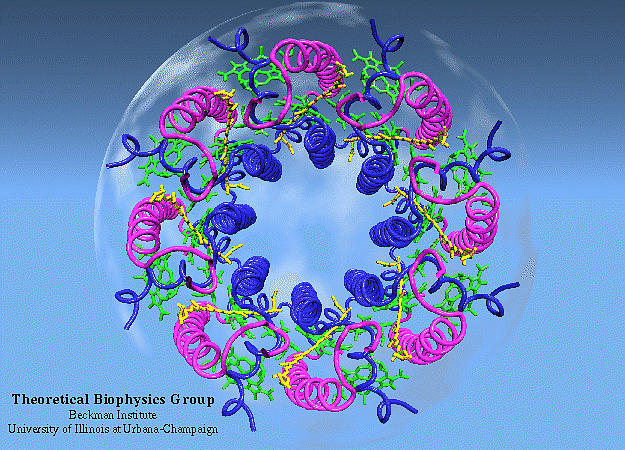
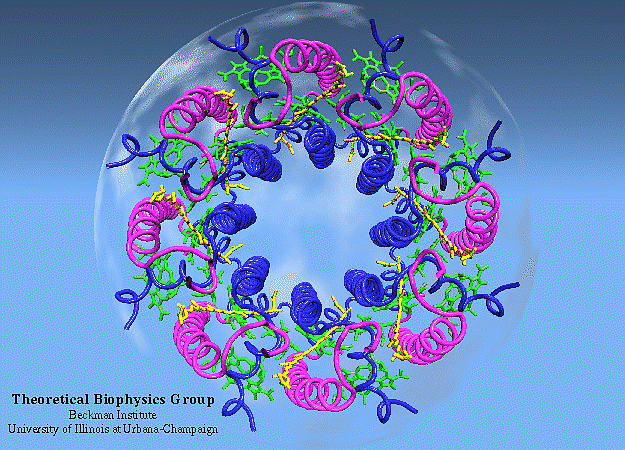
Fig. 6: Light-Harvesting Complex from the Theoretical Biophysics Group, UIUC (http://www.ks.uiuc.edu/Research/bio_ener/LH_2/lh2-big.gif). “Photosynthetic Antennas and Reaction Centers: Current Understanding and Prospects for Improvement,” by Robert E. Blankenship at Washington University St. Louis (http://bioenergy.asu.edu/photosyn/education/antenna.html). It is a well-done text with basic diagrams. We recommend it to all students. “Light Harvesting Complex II of photosynthetic bacteria” from the Theoretical and Computational Biophysics Group (TCBG) at UIUC (http://www.ks.uiuc.edu/Research/bio_ener/LH_2/). See Fig. 6. The group also presents “Inter-Complex Excitation Transfer in photosynthetic bacteria” (http://www.ks.uiuc.edu/Research/psu/psu_inter.html) with excellent colored versions of the antenna complexes in photosynthetic bacteria; links are provided to PDF files of three of their research papers. “Organization of energy transfer networks in photosynthesis” (http://www.ks.uiuc.edu/Research/psres/) also from the TCBG (see above) compares light harvesting mechanisms of anoxygenic and oxygenic photosynthetic bacteria. “Untangling the Quantum Entanglement Behind Photosynthesis” by Graham R. Fleming (http://www.sciencedaily.com/releases/2010/05/100510151356.htm) discusses quantum entanglement in light harvesting complexes. The Wikipedia article on the “Light Harvesting Complex” (http://en.wikipedia.org/wiki/Light_harvesting_complex) is a good introduction to the complex. A second Wikipedia article covers “Light-harvesting complexes of green plants” (http://en.wikipedia.org/wiki/Light-harvesting_complexes_of_green_plants). Electron transfer is described at the following site: http://www.rpi.edu/dept/bcbp/molbiochem/MBWeb/mb1/part2/redox.htm. The Marcus equation for electron transfer is given at http://goldbook.iupac.org/M03702.html. The interactive link maps on this site link to many very important equations. “Electron Transport and Energy Transduction” by John Whitmarsh at UIUC and the USDA Agricultural Research Service (http://www.ars.usda.gov/Services/docs.htm?docid=3527&page=2): It is a good review chapter from the book “Photosynthesis: A Comprehensive Treatise” edited by A. S. Raghavendra. The Z-Scheme is the description of the electron transfer in oxygenic photosynthesis. The scheme and its description are presented at http://www.life.illinois.edu/govindjee/textzsch.htm. [For the scheme itself, see http://www.life.illinois.edu/govindjee/ZSchemeG.html]. However for a 2010 scheme, see Figure 3, shown above. Wikipedia has a lengthy article on the “Electron transport chain” (http://en.wikipedia.org/wiki/Electron_transport_chain) that covers several aspects of the subject. YouTube includes a brief video on the “Electron-Transport Chain” from Essential Cell Biology, 3rd edition (http://www.YouTube.com/watch?v=KXsxJNXaT7w&feature=related) (2:16 min.). Bacterial Photosystem/Photosystems I and II The Protein Data Bank has excellent information on both Photosystem I (http://www.rcsb.org/pdb/101/motm.do?momID=22) and Photosystem II (http://www.rcsb.org/pdb/101/motm.do?momID=59) John Golbeck has posted an excellent PDF, “Photosynthetic Reaction Centers: So little time, so much to do”, a discussion of PS I that can be found at: http://www.biophysics.org/Portals/1/PDFs/Education/golbeck.pdf. Carl Bauer’s lab at Indiana University (http://sites.bio.indiana.edu/~bauerlab/): The site contains nice descriptions and figures for several research projects, e.g., photosystem gene regulation by oxygen and light. It also has information on the origin and evolution of bacterial photosynthesis. You can click on an individual topic. “Shedding New Light on the Earth’s Powerstation” from NASA describes the crystallizing of Photosystem I (PSI) on the space shuttle (http://science.nasa.gov/science-news/science-at-nasa/1998/msad27jul98_1/) and (http://science.nasa.gov/newhome/headlines/msad10may99_1.htm): It is a technical achievement. A second group of PS I crystallization experiments was destroyed in the re-entry crash of the space shuttle Columbia (http://www.asu.edu/news/faculty_students/shuttle_020703.htm). The Virtual Cell Animation Collection at North Dakota State University has a good article and flash animations on “Photosystem II: First Look” (http://vcell.ndsu.nodak.edu/animations/photosystemII/first.htm). “Photosystems I + II” from James Barber at Imperial College (http://www.bio.ic.ac.uk/research/barber/index.htm) shows work being done and the two photosystems in the Barber lab. Wikipedia has good articles on both Photosystem I (http://en.wikipedia.org/wiki/Photosystem_I) and Photosystem II (http://en.wikipedia.org/wiki/Photosystem_II). The Theoretical and Computational Biophysics Group at the University of Illinois covers “The Tale of Two Photosystems” (http://www.ks.uiuc.edu/Research/psres/plantps1.html) in a discussion of the differences of the types of Photosystem I found in cyanobacteria and plants.
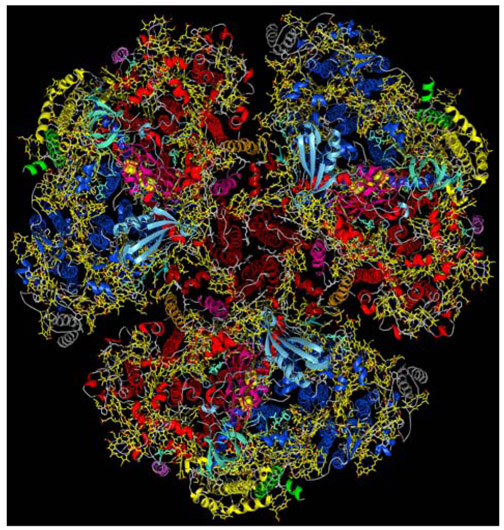
Fig. 7. Structure of Photosystem I determined using X-ray crystallography in Petra Fromme's lab at Arizona State University.
YouTube video: “Light capture by Photosystem I (http://www.YouTube.com/watch?v=UsV-PL3dJA0). YouTube has a good brief animated video on “Photosystem II” (http://www.YouTube.com/watch?v=3UfV060N27g) showing the electron transfer process. The video is provided by the Virtual Cell Animation Collection, from North Dakota State University. Cytochromes and Cytochrome Oxidase “Models for Cytochrome c Biogenesis” from Robert Kranz at the University of Hamburg (http://www.biologie.uni-hamburg.de/b-online/ibc99/wustl/faculty/kranz/models.html): It discusses three different systems for the biogenesis of cytochromes c. “Cytochrome c Oxidase” from the Theoretical and Computational Biophysics Group at the University of Illinois at Urbana (http://www.ks.uiuc.edu/Research/bio_ener/cco/): There is a basic description, and there are some key references. “The bc1-Complex Site” from Antony Crofts at the University of Illinois at Urbana (http://www.life.illinois.edu/crofts/bc-complex_site/index.html) and Ed Berry’s Cyt bc page (http://sb20.lbl.gov/cytbc1/): These sites contain the structure obtained by Ed Berry’s group; Crofts page has links to coordinate data files of structures including that from J. Deisenhofer’s group. “Structure-Function Studies of the Cytochrome b6f Complex” on William Cramer’s Web page at Purdue University (http://www.bio.purdue.edu/lab/cramer/cytbf.html): Here, you will find an excellent description of this complex. Wikipedia has a brief articles on “Cytochrome” (http://en.wikipedia.org/wiki/Cytochrome) and “Cytochrome c oxidase” (http://en.wikipedia.org/wiki/Cytochrome_c_oxidase). “ATP Synthase” by John Walker, the work that won him the Nobel Prize (http://www.mrc-mbu.cam.ac.uk/research/atp-synthase): It is a beautiful site with many excellent illustrations and an incredible animation of the ATP synthase (http://www.mrc-mbu.cam.ac.uk/research/atp-synthase/molecular-animations-atp-synthase) and breakdown of the subunits (http://www.mrc-mbu.cam.ac.uk/research/atp-synthase/structures-domains-atp-synthase) (Fig. 8). The rotary mechanism video is also available on YouTube (http://www.YouTube.com/watch?v=J8lhPt6V-yM&feature=related).
Fig. 8. Rotary mechanism of ATP Synthase from John Walker's Web site: http://www.mrc-mbu.cam.ac.uk/research/atp-synthase/molecular-animations-atp-synthase “Animation Movies of ATP Synthase” by Hongyun Wang and George Oster of University of California, Santa Cruz and Berkeley (http://users.soe.ucsc.edu/~hongwang/Project/ATP_synthase/) are great fun. Enjoy the site and learn from it. “ATP Synthase”, from Antony Crofts at the University of Illinois at Urbana, includes description and crystal structure (http://www.life.illinois.edu/crofts/bioph354/lect10.html). “The Photosynthetic ATP Synthase: Assembly of Hybrid Complexes from Bacterial and Plant Subunits Defines Their Roles in Catalysis” by the late Zippora Gromet-Elhanan at the Weizmann Institute of Science (http://www.weizmann.ac.il/Biological_Chemistry/scientist/Elhanan/elhanan.html). It contains results from her research. (Her obituary appears in Photosynthesis Research, volume 96: 117–119.) Wikipedia has a good article on “ATP synthase” (http://en.wikipedia.org/wiki/ATP_synthase). Boris A. Feniouk maintains the “ATP Synthase Web Page” (http://www.atpsynthase.info/) with many links to information, papers, images, and more. YouTube video “Gradients (ATP Synthases)” from North Dakota State University (http://www.YouTube.com/watch?v=3y1dO4nNaKY) (3:46 min.). C3, C4 and CAM (Crassulacean Acid Metabolism) Pathways “C3, C4 and CAM, Regulation of the Activity of Photosynthesis” from Botany Online at the University of Hamburg (http://www.biologie.uni-hamburg.de/b-online/e24/24b.htm) includes useful information. “How Plants Cope with the Desert Climate”, by Mark A. Dimmitt, Arizona-Sonoran Desert Museum (http://www.desertmuseum.org/programs/succulents_adaptation.html): It is a basic general description of the CAM pathway written for the public. Brad Fiero of Pima Community College presents a brief, easily understood definitions of C3, C4 and CAM photosynthesis (http://wc.pima.edu/~bfiero/tucsonecology/plants/plants_photosynthesis.htm), highly recommended for students. The Princeton/Rutgers Environmental Science Institute has posted “Global Warming Influences on C3 and C4 Photosynthesis” which is a workshop on the subject and contains information of possible interest to teachers: (http://www.woodrow.org/teachers/esi/1999/princeton/projects/c3_c4/). For fun, a low-budgetYouTube video featuring sock puppets doing the “C4 Photosynthesis Rap” (http://www.YouTube.com/watch?v=Ux1eted7nGE). LOL! Wikipedia has brief articles on ‘C3 carbon fixation” (http://en.wikipedia.org/wiki/C3_carbon_fixation), “C4 carbon fixation” (http://en.wikipedia.org/wiki/C4_carbon_fixation), and “CAM photosynthesis” (http://en.wikipedia.org/wiki/Crassulacean_acid_metabolism). The Kahn Academy also has video lessons on “C-4 Photosynthesis” (https://www.khanacademy.org/science/biology/photosynthesis/v/c-4-photosynthesis) and “CAM Plants” (https://www.khanacademy.org/science/biology/photosynthesis/v/cam-plants?playlist=Biology). “Chlorophyll Fluorescence and Definitions” from Optisci (http://www.optisci.com/cf.htm) is a good introduction to chlorophyll fluorescence from a commercial company. We wish more companies would post instructive information such as this, besides merely advertising their products. “Using Chlorophyll Fluorescence to Study Photosynthesis” from the Swiss Federal Institute of Technology, Zurich (ETH) (http://jaguar.fcav.unesp.br/download/deptos/biologia/durvalina/TEXTO-71.pdf): It is a reference paper (PDF) with many figures and references for students. Govindjee has also set up a page for the Kautsky Effect with a QuickTime movie showing the effect (http://www.life.illinois.edu/govindjee/movkautsky.html). A QuickTime plug-in is required. “Chlorophyll fluorescence — a practical guide” (http://jxb.oxfordjournals.org/cgi/content/full/51/345/659) is a well-written review article provided as a service to schools by the Journal of Experimental Botany. Those that cannot connect to this site can download the free PDF version (http://jxb.oxfordjournals.org/cgi/reprint/51/345/659.pdf). Chlorophyll a Fluorescence: A Signature of Photosynthesis, edited by G. C. Papageorgiou and Govindjee, is now available in softcover as well as an e-book at libraries that subscribe to it. Readers can download free Front Matter of the book, which includes all the colored plates, (http://www.springerlink.com/content/978-1-4020-3217-2). Wikipedia has an article on “Chlorophyll fluorescence” (http://en.wikipedia.org/wiki/Chlorophyll_fluorescence). “An Introduction to Herbicides” (http://ipmworld.umn.edu/chapters/whitacreherb.htm): This site contains structures of many herbicides including Atrazine; Paraquat; Glyphosate, among others. There are also references and a link to a Spanish version. “Photosynthesis Inhibitors” (http://www.btny.purdue.edu/weedscience/MOA/Photosynthetic_Inhibitors/text.html) from the Department of Botany at Purdue includes brief descriptions and also time-lapse videos. “Herbicide Mode-Of-Action Summary” by M.A. Ross and D.J. Childs of Crop Extension Service of Purdue University (http://www.ces.purdue.edu/extmedia/WS/WS-23-W.html) discusses the overall manner in which a herbicide affects a plant at the tissue or cellular level. “Photosynthesis Inhibitors” from the Sugarbeet Research & Education Board (http://www.sbreb.org/brochures/herbicide/photo.htm) discusses agricultural use of herbicides. “Virtual Cell” is a journey into the workings of the chloroplast, from the Department of Plant Biology at UIUC (http://www.life.illinois.edu/plantbio/cell/): This award-winning site by Matej Lexa is indeed a fun site. You can cut, zoom, turn, and really look at the “innards” of the chloroplast. The American Society for Photobiology has posted “Light and Chloroplast Enzyme Activity” by Peter Schürmann: http://www.photobiology.info/Schurmann.html Wikipedia has a very detailed article about chloroplasts (http://en.wikipedia.org/wiki/Chloroplast). Biology 4Kids (http://www.biology4kids.com/files/cell_chloroplast.html) has easy to understand explanations and figures suitable for younger students. FT Exploring is another site suitable for younger students (http://www.ftexploring.com/photosyn/chloroplast.html). It has good explanations, gives simple overviews and then much more detailed information for older students. “The Chloroplast Genome and Chloroplast Gene Expression” (http://hstalks.com/main/view_talk.php?t=522&r=14&j=755&c=252) is video talk by Christopher Howe discussing the chloroplast genome. Wikipedia has a good article with numerous figures on “Chloroplast” (http://en.wikipedia.org/wiki/Chloroplast). YouTube video: “Bill Nye The Science Guy – Chloroplasts” is not really by Bill Nye, but a fun student bio project featuring cardboard cutouts explaining the structure of chloroplasts (http://www.YouTube.com/watch?v=dax7v711qg0&feature=related). Wacky fun and sometimes out-of-control. “Photosynthetic Pigments” from the University of California, Berkeley (http://www.ucmp.berkeley.edu/glossary/gloss3/pigments.html): It is a nice site discussing the three major pigments of plants, algae and cyanobacteria: chlorophylls; phycobilins; and carotenoids. The site also describes the characteristics of plants and cyanobacteria (there are nice pictures of cyanobacteria and suspensions of some algae). The International Carotenoid Society (http://www.carotenoidsociety.org/) links to the chemical structures of many common carotenoids and articles, as well as its own newsletters. Wikipedia covers several aspects of carotenoids (http://en.wikipedia.org/wiki/Carotenoid). “Nomenclature of Carotenoids” (http://www.chem.qmul.ac.uk/iupac/carot/) has the very detailed IUPAC scientific rules for naming carotenoids. Although primarily useful only to specialists, it does give the public a taste for the complexities of naming chemical compounds. For a 1998 article on a historical perspective on carotenoids in photosynthesis, “Carotenoids in Photosynthesis: An Historical Perspective,” go to: http://www.life.illinois.edu/govindjee/papers/CarFin1.html The Linus Pauling Institute at Oregon State University presents “Carotenoids” (http://lpi.oregonstate.edu/infocenter/phytochemicals/carotenoids/) devoted to the uses of carotenoids in nutrition. Wikipedia article on “Carotenoid” (http://en.wikipedia.org/wiki/Carotenoid). Rubisco (Ribulose Bisphosphate Carboxylase Oxygenase)
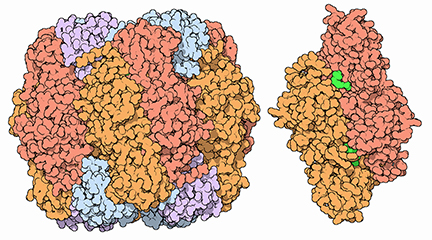
Fig. 9. Rubisco from the Protein Data Bank (http://www.rcsb.org/pdb/101/motm.do?momID=11) . “Rubisco: A First Look at the Mechanism” from the School of Crystallography at Birbeck, University of London (http://www.scicom.demon.co.uk/RubJmol/Rubisco%20proj/Title_Page.html): A bit out of date, but is still a very good site that tells you what Rubisco is, its mechanism of action and provides many useful references. (Note: use the Jmol version as this plug-in is included in Java aware browsers. The Chime versions are no longer working.) The Protein Data Bank covers “Rubisco” (http://www.rcsb.org/pdb/101/motm.do?momID=11) in detail. See Fig. 9. Wikipedia has a very good article on Rubisco (http://en.wikipedia.org/wiki/RuBisCO). As usual, we would like the readers to read “Calvin cycle” as “Calvin-Benson” cycle. The discovery of Rubisco is discussed in Vivienne Baillie Gerritsen’s interesting article in Protein Spotlight, “The Plant Kingdom’s Sloth” (http://www.expasy.org/spotlight/back_issues/sptlt038.shtml). If you like humorous top ten lists, check out the “I Love Rubisco” site at (http://www.sabregirl.freeservers.com/rubisco.html). Our favorite is “#8: Space filling models look kind of like Hortas — (Star Trek (We're almost as geeky as engineers)).” Whole Plant Photosynthesis and Plant Stress Free-Air CO2 Enrichment Project (FACE) cooperative projects are being set up around the globe to study the impact of carbon dioxide on plants and crops growing in the open environment. A few sites of interest are: The Face Program (http://www.bnl.gov/face/faceProgram.asp); USDA-ARS sites in Arizona studying effects on cotton and wheat (http://www.ars.usda.gov/research/projects/projects.htm?accn_no=409185); Australian Savanna FACE (http://www.cse.csiro.au/research/ras/ozface/index.htm); EuroFACE (http://www.unitus.it/euroface/); Oakridge: A FACE experiment in a deciduous forest (http://www.esd.ornl.gov/facilities/ORNL-FACE/). There are many more; the full list is at: http://public.ornl.gov/face/global_face.shtml. SoyFACE (Soybean Free Air Concentration Enrichment) is an innovative facility in Urbana, Illinois, for growing crops under higher levels of carbon dioxide and ozone: http://soyface.illinois.edu/index.htm. Some of the photos in the middle of the top banner are those of two of the leaders there: Steven Long (http://www.life.illinois.edu/long/) and Donald R. Ort (http://www.life.illinois.edu/ort/). “Field Photosynthesis Measurement Systems” from New Mexico State University (http://hydrology1.nmsu.edu/Teaching_Material/soil698/Student_Material/Photosynthesis/): This site describes LICOR Gas exchange systems and their use for measuring whole plant photosynthesis. Wikipedia does a good job covering “Plant stress measurement” (http://en.wikipedia.org/wiki/Plant_stress_measurement ). The “Plant Stress Genomics Research Center (PSGR) (http://www.kaust.edu.sa/research/centers/plant.html) at King Abdullah University of Science and Technology studies how plants tolerate salt and drought conditions. “FIFE Canopy Photosynthesis Rates Data Set Guide Document” is a technical report from Oak Ridge National Laboratory (http://www-eosdis.ornl.gov/FIFE/Datasets/Vegetation/Canopy_Photosynthesis_Rates.html). This site presents details of data on “Canopy Photosynthesis”, collected in 1987 at several sites and revised in 2010. The Fleming group at the Berkeley lab discusses “How are photosynthetic organisms able to protect themselves from energy-related damage?” (http://www.cchem.berkeley.edu/grfgrp/pages/Question_Pages/NPQ.html) The article discusses dissipation of excess excitation energy and nonphotochemical quenching. YouTube video “the Plant That Doesn’t Feel the Cold” from the John Innes centre in Norwich, UK, discusses modifying plants to better deal with temperature stress and climate change (http://www.YouTube.com/watch?v=3KmT5xlCaC4&feature=player_embedded). Mike Jones from the University of Bristol provides “Bacterial Photosynthesis” (http://www.photobiology.info/Jones.html); it is a good introduction to the subject. “Introduction to the Cyanobacteria” [cyanobacteria are oxygenic photosynthesizers] from the University of California, Berkeley (http://www.ucmp.berkeley.edu/bacteria/cyanointro.html): It shows two nice photographs of cyanobacteria and gives a short description. Follow the in-text links and you will be rewarded with a great deal of information on the history of cyanobacteria going back more than a billion years. It also includes information on pigments, how these cyanobacteria changed the very atmosphere we breathe, and led to the existence of plants. “Purple Non-Sulfur Photosynthetic Bacteria” [these bacteria are anoxygenic photosynthesizers] that supports the Bacteriology 102 course from the University of Wisconsin (http://www.splammo.net/bact102/102pnsb.html): It is a good teaching site at undergraduate level. It includes nice photos of bacterial cultures; description of bacteria and the media they are grown in. The American Society of Photobiology has posted “Bacterial Photosynthesis” by Mike Jones: http://www.photobiology.info/Jones.html “Chlorobi: Green Sulfur Bacteria” (http://bmb-it-services.bmb.psu.edu/bryant/lab/Project/GSB/index.html) by Don Bryant at Penn State University contains introductory information on the green sulfur bacteria and links to genomic information. Niels-Ulrik Frigaard at the University of Copenhagen discusses “Molecular Microbial Physiology” (http://www.bio.ku.dk/nuf/) with emphasis on the phototrophic sulfur bacteria, cyanobacteria, marine bacteria and much more. YouTube video: “Photosynthesis in Bacteria (Rhodopseudomonas Viridis)” (http://www.YouTube.com/watch?v=J5Nz4cQJ2u8) gives a simple animated introduction to bacterial photosynthesis. “Early Evolution of Photosynthesis” by Robert E. Blankenship (http://www.plantphysiol.org/content/154/2/434.full) was first published in Plant Physiology in 2010. It is now available to the general public and is a very good introduction to the subject. PDF versions and even PowerPoint files are included. “Origin of Microbial Life and Photosynthesis “from Carl Bauer at Indiana University (http://www.bio.indiana.edu/~bauerlab/origin.html): The site has a clear text; beautiful evolutionary trees; and the photosynthetic gene cluster of heliobacteria. “When did oxygenic photosynthesis evolve?” by Roger Buick (http://www.ncbi.nlm.nih.gov/pmc/articles/PMC2606769/) discusses the “Great Oxidation Event” and its relationship to biological oxygen production. “The Manganese-calcium oxide cluster of Photosystem II and its assimilation by the Cyanobacteria” by James D. Johnson (http://www.chm.bris.ac.uk/motm/oec/motm.htm) discusses the evolution of the oxygen-evolving complex in bacteria. It is very complete and contains many good illustrations and chemical structures. “Geobiologists Solve “Catch-22 Problem” Concerning the Rise of Atmospheric Oxygen” (http://www.caltech.edu/content/geobiologists-solve-catch-22-problem-concerning-rise-atmospheric-oxygen) is a news release from Caltech that discusses some puzzles about the early evolution of cyanobacteria and their ability to produce oxygen without poisoning themselves. “Using the present to inform the past: interpreting potential biomarkers of (an)oxygenic photosynthesis” (http://www.dknlab.caltech.edu/Metabolism.html) is a discussion of the evolution of photosynthesis from Dianne K. Newman’s lab at MIT. She also has a video on “From Rocks to Genes and Back: Stories About the Evolution of Photosynthesis” is a lecture given at an MIT seminar (http://video.mit.edu/watch/from-rocks-to-genes-and-back-stories-about-the-evolution-of-photosynthesis-9299/) (43 min.). Video: Paul Falkowski discusses “Electrons, Life and the Evolution of the Oxygen Cycle on Earth” another lecture in the MIT series (http://video.mit.edu/watch/electrons-life-and-the-evolution-of-the-oxygen-cycle-on-earth-9298/) (53:35 min.). Falkowski’s talk begins at about the 5 minute mark. Photosynthesis and the Environment / Global Climate Change “The Climate Desk” (http://theclimatedesk.org/) is a collaboration of writers from the Atlantic, Grist, Mother Jones, Wired, Slate, and others. It features reprint articles about the impact of global climate change on humans, the environment, economies, and politics. It also has a Facebook site: http://www.facebook.com/theclimatedesk The National Climatic Data Center (NCDC) and National Oceanic and Atmospheric Administration (NOAA) have set up a very good FAQ site for “Global Warming” (http://www.ncdc.noaa.gov/oa/climate/globalwarming.html) NASA presents “Global Climate Change: Vital Signs of the Planet” (http://climate.nasa.gov/) with much good information and good links. A special section is devoted to “Climate Kids” (http://climatekids.nasa.gov/) with information for younger students. The Intergovernmental Panel on Climate Change (IPCC) has set up a site with a great deal of information (http://www.ipcc.ch/). There are links to their reports, meetings, figures and much more, including links to the controversies regarding possible errors in the research. 350.org (http://350.org) is a major blog discussing climate change and a grass roots organization dedicated to reducing the amount of CO2 from its current level of 392 parts per million to below 350 ppm. The Center for Climate and Energy Solutions (C2ES) (http://www.c2es.org/ ) covers governmental policies at the local, national and international levels as well as covering environmental aspects of technology, science and business. A Wikipedia presentation on “Climate change denial” that is used to describe attempts to downplay the extent of global warming and its impact: http://en.wikipedia.org/wiki/Climate_change_denial. The iTunes Open University site has set up a section on “Environment, Development and International Studies which have good sections on “Environmental ethics,” “Energy policy and climate change” and more. Access to the sites is through the iTunes store via the Internet. “Greenhouse Gases and Society” by Nick Hopwood and Jordan Cohen from the University of Michigan (http://pratclif.com/climatechange/Greenhouse%20Gases.htm) covers many aspects including the Greenhouse Effect, greenhouse gases, effects on the environment and society. It has many good figures. “The Decade After Tomorrow: Modeling Global Climate Change at Berkeley” (http://sciencereview.berkeley.edu/articles/issue7/greenhouse.pdf) by Kristen DeAnglis discusses work being done at UC-Berkeley. It is a good general article in PDF format that discusses the problem and its complexities. The U.S. Environmental Protection Agency (EPA) has a substantial Web site with many good links to discussions of the problem of global warming, climate policy and useful hints as well as links to other resources (http://www.epa.gov/climatechange/). The EPA site also has a student’s guide to “Global Climate Change” (http://www.epa.gov/climatechange/students/index.html) with simple explanations and links. “RealClimate” (http://www.realclimate.org/) is an important site for information on climate change information written by working climate scientists. It has sections for beginners and those with more knowledge about climate change issues. Curious about the Kyoto Protocol? Here is the full text: http://unfccc.int/resource/docs/convkp/kpeng.html. “Photoinhibition in Antarctic Phytoplankton by Ultraviolet-B Radiation in Relation to Column Ozone Values” from NSF’s Office of Polar Programs (http://www.nsf.gov/od/opp/antarct/ajus/nsf9828/9828html/j1.htm): It is a short article; has some references; and deals with ozone-related problems. William Calvin, from the University of Washington, presents information about climate change, including his famous lectures, at http://www.williamcalvin.com/index.html. “Teaching Climate Change: Lessons for the Past” from Carleton University (http://serc.carleton.edu/NAGTWorkshops/climatechange/index.html) presents a comprehensive list of resources to help understand and teach about climate change at many levels. Highly recommended. They also have a second site “Teaching About Energy in Geoscience Courses” (http://serc.carleton.edu/NAGTWorkshops/energy/index.html) that also contains useful links. "Liberated Carbon" (http://vimeo.com/72488296#) is sung by Andy Revkin at the 2013 Science Online Climate Conference. YouTube video: “Singing Minstrels – Teaching Kids about Climate Change” (http://www.YouTube.com/watch?v=DguUQamkH0A) 28 min. Environmental educators use music to teach children about climate change. History of Photosynthesis/Biographies/Nobel Prizes The American Society of Photobiology has posted “Photosynthesis Timelines” by Thomas Brennan: http://www.photobiology.info/History_Timelines/Hist-Photosyn.html “Milestones in Photosynthesis Research” by one of us (G) (http://www.life.illinois.edu/govindjee/papers/milestones.html) explores many aspects of photosynthesis in a historic manner. James Fulton from Suffolk County Community College has written a long informative outline of “The History of Photosynthesis” covering many historical events to 1988 that is available as a Word document (http://www2.sunysuffolk.edu/fultonj/SUNY_Suffolk_Resources/Math_Laboratories/Lab_3/hist.doc). Another paper, “Carotenoids in Photosynthesis: An Historical Perspective,” explores the history of the study of carotenoids using numerous personal observations by one of the authors (G) who participated in many of the activities (http://www.life.illinois.edu/govindjee/papers/CarFin1.html). Both of these papers contain numerous references and anecdotes about pioneers in the field that can be found nowhere else. A list of historical articles, published in Photosynthesis Research, is available at: http://www.life.illinois.edu/govindjee/history/articles.htm. Further, PDF files of articles by Howard Gest (on Ingenhousz); Herb Dutton (on the discovery of energy transfer from carotenoids to chlorophyll); and Govindjee (on the quantum yield controversy between Emerson and Warburg) are also available at this site. Jane Hill has recently published “Chemical Research on Plant Growth: A translation of Théodore de Saussure's Recherches chimiques sur la Végétation (2013). See <http://www.amazon.com/Chemical-Research-Plant-Growth-translation/dp/1461441358 >It is a wonderful translation and explanation of de Saussure’s groundbreaking work on photosynthesis. Other important historical documents are: “Nobel Prize Winners in Photosynthesis Research” (http://www.life.illinois.edu/govindjee/history/nobel-ps.htm) is a list of the many researchers who have won the Nobel Prize while or before studying photosynthesis. A large number of Personal Perspectives, autobiographical retrospectives, edited by Govindjee et al., and published in the international journal Photosynthesis Research are found at : (http://www.life.illinois.edu/govindjee/g/PhotoEdHistory.html). Although these perspectives usually may not contain large amounts of science, they do discuss the major discoveries by well-known researchers. In particular, they contain the personal reflections, memories and the obstacles the authors had to overcome and other surprises. For example, the Personal Perspective of David Walker begins, “This is the story of a young man who wished to go to sea like his father and finished up, instead, in photosynthesis.” They are great reading and tell about scientific research the way it “really is.” Over 100 of these perspectives by 132 authors in 19 countries have been collected in Discoveries in Photosynthesis, edited by Govindjee, J. Thomas Beatty, Howard Gest and John F. Allen (http://www.life.illinois.edu/govindjee/newbook/Vol%2020.html). The table of content of this book is available at (http://www.springerlink.com/content/978-1-4020-3323-0); also, you can download the Front Matter and the Back Matter. A few of the earlier perspectives are available as PDF files. David Krogmann (http://www.life.illinois.edu/govindjee/history/KrogmannDavidPP.pdf); R. Clint Fuller (http://www.life.illinois.edu/govindjee/history/FullerClintPP.pdf); Giorgio Forti (http://www.life.illinois.edu/govindjee/history/FortiGeorgioPP.pdf); André Jagendorf (http://www.life.illinois.edu/govindjee/history/JagendorfAndrePP.pdf); George Feher (http://www.life.illinois.edu/govindjee/history/FeherGeorgePP.pdf); David Walker (http://www.life.illinois.edu/govindjee/history/WalkerPP.pdf) Govindjee has also edited several obituaries that have been published (http://www.life.illinois.edu/govindjee/history/obituaries.htm), with some of them available online as PDF files. Others are available at the Web site of Photosynthesis Research (http://www.springerlink.com/content/100325/), available free to members of the International Society of Photosynthesis Research (ISPR), or at your local library if they subscribe to the journal. Carmen Giunta has collected excerpts from historically important papers and published them on his “Classic Chemistry” Web site. These include papers by Jan Ingenhousz (http://webserver.lemoyne.edu/faculty/giunta/Ingenhousz.html), Antoine Lavoisier (http://webserver.lemoyne.edu/faculty/giunta/lavoisier1.html), Joseph Priestley (http://webserver.lemoyne.edu/faculty/giunta/phlogiston.html). Another paper of interest includes early work on the greenhouse effect by Svante Arrhenius (http://web.lemoyne.edu/~giunta/Arrhenius.html). Besides these, there are many other selected classic papers form the history of chemistry (http://web.lemoyne.edu/~giunta/paperabc.html) Today in Science History has a listing of brief, but important, quotations from historical figures such as van Helmont, Ingenhousz, etc. (http://www.todayinsci.com/QuotationsCategories/P_Cat/Photosynthesis-Quotations.htm). The site also has an interesting story about “The Sun as a Chemist” (http://www.todayinsci.com/stories/story054.htm). A sample: “Indeed, instead of building factories, furnishing them with unique equipment and working out complex synthesis technologies, it will only be necessary to build hothouses and to regulate the intensity and spectral composition of the light rays used. Then the plants themselves will make everything required: from the simplest carbohydrates to the most complex proteins.” A brief biography of Joseph Priestley can be found at http://www.chemistry.mtu.edu/~pcharles/SCIHISTORY/JosephPriestley.html. Biographies of Jan Ingenhousz can be found at http://www.chemheritage.org/explore/life-ingenhousz.html, http://www.newadvent.org/cathen/16046b.htm and http://www.answers.com/topic/jan-ingenhousz The Nobel Prize site has pages devoted to all Nobel laureates. Some of interest to photosynthesis are: Richard Martin Willstätter, Chemistry, 1915, won the prize for his research on chlorophyll and other plant pigments. His work is discussed at: http://nobelprize.org/nobel_prizes/chemistry/laureates/1915/present.html and his biography is at: http://nobelprize.org/nobel_prizes/chemistry/laureates/1915/willstatter-bio.html. James Franck, Physics, 1925, won for his work (with Gustav Hertz) on electron-atom collisions; later he developed the principle known as the Franck-Condon principle which is often used in physical description of early events in photosynthesis. See (http://nobelprize.org/nobel_prizes/physics/laureates/1925/press.html) and his biography (http://nobelprize.org/nobel_prizes/physics/laureates/1925/franck-bio.html) Chandrasekhara Venkat Raman, Physics, 1930, won his prize for his work on spectroscopy and the effect that now bears his name, Raman spectroscopy, which is used by many photosynthesis researchers: (http://nobelprize.org/nobel_prizes/physics/laureates/1930/press.html). His biography is at (http://nobelprize.org/nobel_prizes/physics/laureates/1930/raman-bio.html). Hans Fischer, Chemistry, 1930, won for his work on porphyrins and blood and leaf pigments, particularly chlorophyll: http://nobelprize.org/nobel_prizes/chemistry/laureates/1930/press.html. His biography is at (http://nobelprize.org/nobel_prizes/chemistry/laureates/1930/fischer-bio.html) Otto Heinrich Warburg, Physiology or Medicine, 1931, won for his work on respiration and the identification of the respiratory enzyme: http://nobelprize.org/nobel_prizes/medicine/laureates/1931/press.html. His biography is at (http://nobelprize.org/nobel_prizes/medicine/laureates/1931/warburg-bio.html). Warburg’s insistence that the measured minimum quantum requirement for the evolution of one oxygen molecule in photosynthesis is 2.8 to 4 was proven to be wrong; it was shown to be 8–12, mainly by Robert Emerson and his students including one of us (G). [This is discussed by Govindjee (1999) in Photosynthesis Research 59, 249-254; and in details by K. Nickelsen and Govindjee (2011) The Maximum Quantum Yield Controversy: Otto Warburg and the <<Midwest-Gang>>, Bern Studies in the History and Philosophy of Science.] Paul Karrer, Chemistry, 1937, won for his work on carotenoids, flavins and vitamins: http://nobelprize.org/nobel_prizes/chemistry/laureates/1937/press.html. His biography is at (http://nobelprize.org/nobel_prizes/chemistry/laureates/1937/karrer-bio.html) Richard Kuhn, Chemistry, 1938, won for additional work on carotenoids and vitamins: http://nobelprize.org/nobel_prizes/chemistry/laureates/1938/press.html. His biography is at: (http://nobelprize.org/nobel_prizes/chemistry/laureates/1938/kuhn-bio.html) Severo Ochoa, Physiology or Medicine, 1959, won for his work on enzymatic processes in biological oxidation and synthesis and the transfer of energy. His biography is at (http://nobelprize.org/nobel_prizes/medicine/laureates/1959/ochoa-bio.html)
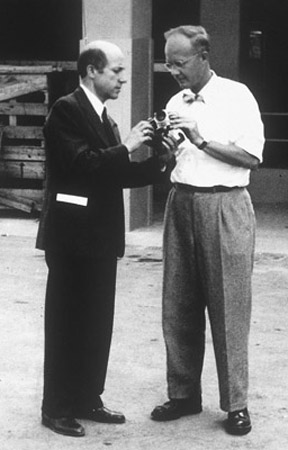
Fig. 10. Andrew Benson (right) with Melvin Calvin (left) outside of the Old Radiation Laboratory (ORL); here Benson is showing Calvin his new Exakta camera that he had bought in Köln, Germany. Photo, 1950s. Melvin Calvin, Chemistry (Fig. 10), 1961, won for his work on carbon dioxide assimilation in photosynthesis, the carbon cycle, also named “The Calvin Cycle” after him: http://nobelprize.org/nobel_prizes/chemistry/laureates/1961/press.html. It is important to mention that Andrew Benson contributed heavily to this work, and the authors of this article prefer to call the cycle, “Calvin-Benson” cycle. (We refer the readers to A. A. Benson (2005) in Discoveries in Photosynthesis, pp 793-813, Springer, for his contributions.). Calvin’s biography is at: (http://nobelprize.org/nobel_prizes/chemistry/laureates/1961/calvin-bio.html). Also, an obituary may be found at: http://www.lbl.gov/Science-Articles/Archive/Melvin-Calvin-obit.html; and another one at: http://www.life.illinois.edu/govindjee/history/obit/ObitMelvinCalvin.pdf. Jeffery Kahn writes about the establishment of the Calvin Photosynthesis Group project at UC Berkeley’s Bancroft Library (http://www.lbl.gov/Science-Articles/Archive/Calvin-history-project.html). More information from the Library is available at http://bancroft.berkeley.edu/Exhibits/Biotech/calvin.html. Robert Burns Woodward, Chemistry, 1965, won for the total synthesis of chlorophyll, vitamin B12 and other natural products: http://nobelprize.org/nobel_prizes/chemistry/laureates/1965/press.html. His biography is at: (http://nobelprize.org/nobel_prizes/chemistry/laureates/1965/woodward-bio.html) George Porter, Chemistry, 1967, won for his development of flash photolysis (along with Ronald Norrish). Lord George Porter later did work on aromatic molecules and chlorophyll, energy transfer in photosynthesis and primary photochemistry of photosynthesis in femtosecond-picosecond time scale: http://nobelprize.org/nobel_prizes/chemistry/laureates/1967/press.html. His biography is at: (http://nobelprize.org/nobel_prizes/chemistry/laureates/1967/porter-bio.html). His obituary (for subscribers) in Nature is available at http://www.nature.com/nature/journal/v419/n6907/full/419578a.html. Peter D. Mitchell, Chemistry, 1978, won for his work on biological energy transfer through the formulation of the chemiosmotic theory: http://nobelprize.org/nobel_prizes/chemistry/laureates/1978/press.html. His biography is at: (http://nobelprize.org/nobel_prizes/chemistry/laureates/1978/mitchell-bio.html. Aaron Klug, Chemistry, 1982, won for development of crystallographic electron microscopy and his structural elucidation of biologically important nucleic acid-protein complexes: http://nobelprize.org/nobel_prizes/chemistry/laureates/1982/press.html. His autobiography is at: (http://nobelprize.org/nobel_prizes/chemistry/laureates/1982/klug-autobio.html) Jean-Marie Lehn, Chemistry, 1987, won for his work on mimicking natural processes such as photosynthesis and for doing the groundwork for small synthetic structures called “molecular devices”: http://nobelprize.org/nobel_prizes/chemistry/laureates/1987/press.html. His autobiography is at: (http://nobelprize.org/nobel_prizes/chemistry/laureates/1987/lehn-autobio.html) Johann Deisenhofer, Robert Huber and Hartmut Michel, Chemistry, 1988, won, for determining the three-dimensional structure of bacterial reaction center using X-ray crystallography. A description of their work can be found at: http://nobelprize.org/nobel_prizes/chemistry/laureates/1988/press.html. Deisenhofer’s autobiography is at: (http://nobelprize.org/nobel_prizes/chemistry/laureates/1988/deisenhofer-autobio.html). Huber’s is at: (http://nobelprize.org/nobel_prizes/chemistry/laureates/1988/huber-autobio.html). And Michel’s is at: (http://nobelprize.org/nobel_prizes/chemistry/laureates/1988/michel-autobio.html) Rudolph Marcus, Chemistry, 1992, won for his contributions to the theory of electron transfer reactions in chemical systems, including photosynthesis: http://nobelprize.org/nobel_prizes/chemistry/laureates/1992/press.html. His autobiography is at: (http://nobelprize.org/nobel_prizes/chemistry/laureates/1992/marcus-autobio.html) Michael Smith, Chemistry, 1993, won for his fundamental contributions to the establishment of oligonucleotide-based, site-directed mutagenesis and its development for protein studies which has become a common technique for studying photosynthesis organisms: http://nobelprize.org/nobel_prizes/chemistry/laureates/1993/press.html. His autobiography may be found at: http://nobelprize.org/nobel_prizes/chemistry/laureates/1993/smith-autobio.html Paul D. Boyer and John E. Walker, Chemistry, 1997, won for their elucidation of the enzymatic mechanism underlying the synthesis of adenosine triphosphate (ATP): http://nobelprize.org/nobel_prizes/chemistry/laureates/1997/press.html. Boyer’s autobiography is at: (http://nobelprize.org/nobel_prizes/chemistry/laureates/1997/boyer-autobio.html), and Walker’s is at: (http://nobelprize.org/nobel_prizes/chemistry/laureates/1997/walker-autobio.html) Ahmed H. Zewail, Chemistry, 1999, won for his studies of the transition states of chemical reactions using femtosecond spectroscopy: http://nobelprize.org/nobel_prizes/chemistry/laureates/1999/press.html. His autobiography may be found at: http://nobelprize.org/nobel_prizes/chemistry/laureates/1999/zewail-autobio.html |
Author Contact Information : Larry Orr Govindjee This Website is based on the Educational Review: Photosynthesis Web Resources. Photosynthesis Research (2013) 115: 179–214, DOI: 10.1007/s11120-013-9840-3 Please contact the authors with any broken links, corrections or suggestions. |
| 22-Aug-2013 |